Modernize your software.
Connect your systems.

Work directly with an engineer to assess an existing application, rebuild a workflow, connect equipment and data, or test a focused AI use case. Scope, validation, and handoff are part of the work.

SOFTWARE / EQUIPMENT / DATAAppRebuilt
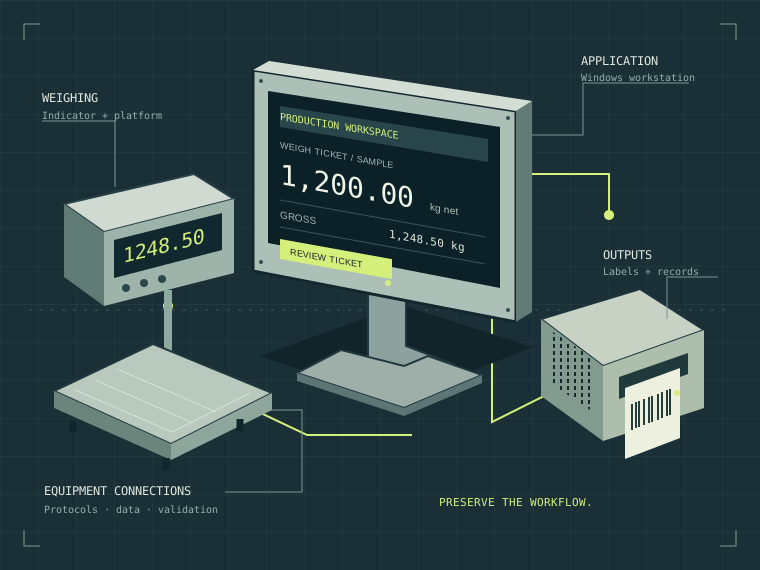
Technical illustration of a Windows workstation connected to a weighing indicator, platform scale, and label printer.
Modernization extends beyond the screen.Illustrative equipment & sample data

Choose a starting point.

Start with the problem and the systems involved. A scoped assessment can establish the next step before committing to a larger implementation.

Application assessment

Document what the application does, how people use it, and which systems it connects to.

  • Workflow and screen inventory
  • Business rules and data requirements
  • Dependencies and compatibility risks

Deliverable: a workflow and dependency map, findings, options, and a proposed implementation scope. Discuss an assessment.

Rebuilding & modernization

Scope a replacement or targeted update around the tasks your operation needs to retain.

  • Required features and integrations
  • Modern Windows compatibility
  • Acceptance and transition planning

Deliverable: an agreed set of workflows, a tested implementation, and a transition plan. Discuss a rebuild.

Support & integration

Investigate the faults and connections that make an older application difficult to maintain.

  • Database and reporting connections
  • Printers, serial devices, and equipment
  • Maintenance and support planning

Deliverable: a bounded integration or repair, diagnostics, and documented operating limits. Discuss an integration.

Applied AI pilots

Test one workflow using approved information, a defined review step, and examples of acceptable output.

  • Document search and evidence-linked answers
  • Draft notes or structured information for review
  • Provider, latency, cost, and failure checks

Deliverable: a bounded prototype, evaluation results, and a recommendation on the next step. See how a pilot works.

Equipment belongs in the scope.

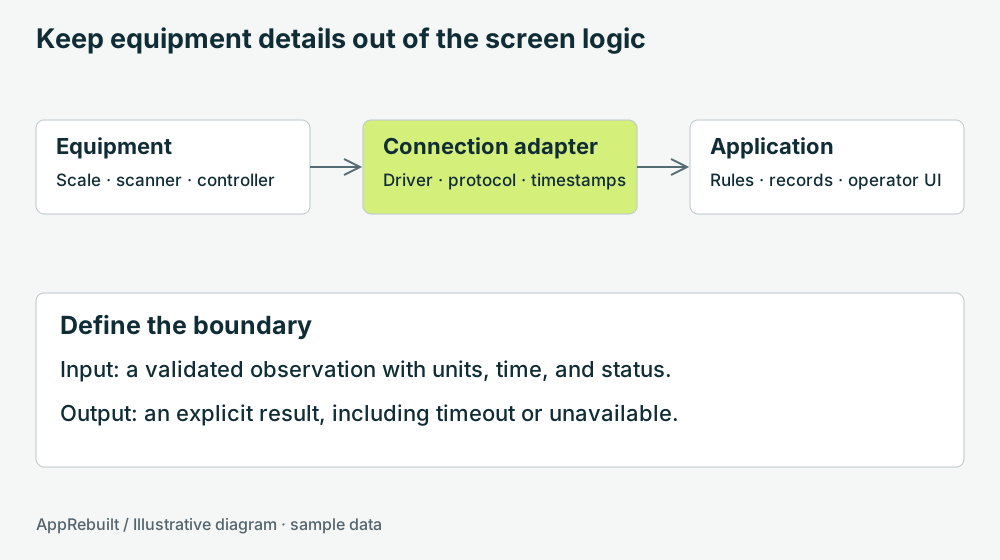
A scale reading, a printed label, a production count. These connections belong in the rebuild from the beginning.

Explore equipment integration ↗

Device protocols, drivers, and safe operating boundaries are assessed for each application.

Scales & serial devices
Readings, units, stability, timeouts, and ticket capture.
Barcode scanners & printers
Item identification, label formats, print queues, and retries.
PLC & production data
Monitoring, data quality, connection state, and access boundaries.
Databases & reporting
Records, calculations, exports, and the systems that use them.

Compare a workflow before and after.

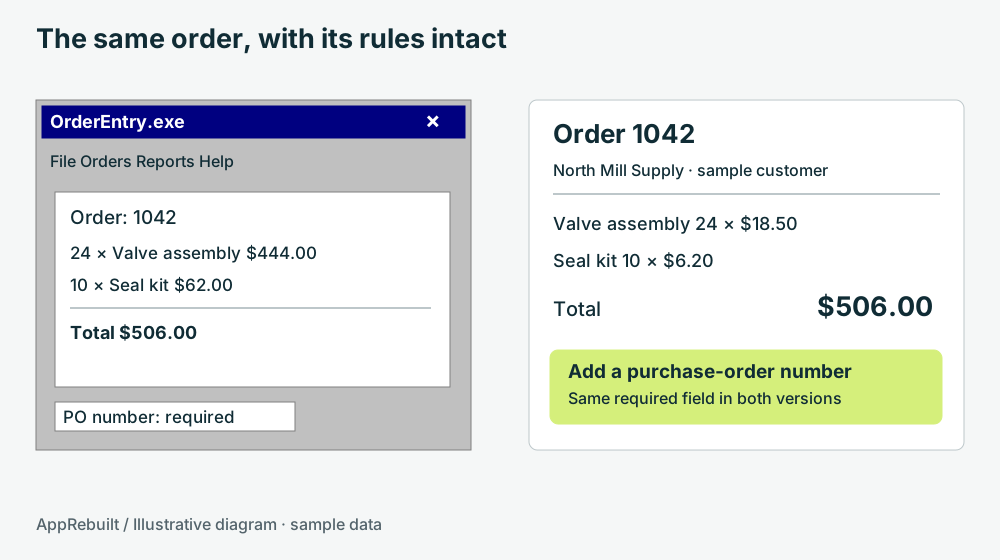
Switch between the two views. The sample orders, quantities, and report fields stay the same. Those details become requirements for the rebuild.

Try all four application examples ↗
What a rebuild can preserveInteractive example
Compare the legacy and rebuilt interfaces
Production ordersOrders.exeSample data

Order register

Daily production report

3 orders
Sample production orders, identical in both interface views
OrderItemQtyStatus
1042Valve assembly240Ready
1043Mounting plate180Ready
1044Seal kit320On hold
Order, item, quantity, statusDownload sample report

Switch views to compare the same records and report fields. This is an illustrative example, not a customer project.

Explore more legacy and modern examples

How a project starts.

The scope follows your application's needs. A compatibility repair, a focused update, and a full rebuild each call for a different plan.

  1. Understand the application

    Walk through real tasks and identify the users, business rules, data, and connected systems.

    Define what must be preserved.

  2. Agree on the work

    Assess the available options and establish the requirements, constraints, and acceptance criteria.

    Choose a scope you can review.

  3. Build, validate, and hand over

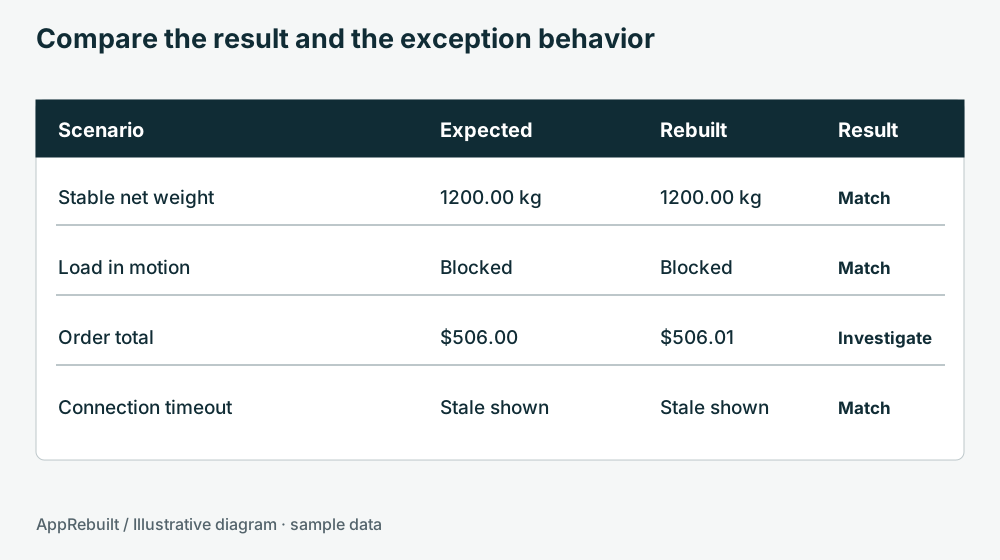
    Compare workflows and outputs with agreed criteria. Plan installation, rollback, operator documentation, and support responsibilities.

    Record what passed and what remains open.

When an application
needs attention.

Plan the work behind the rebuild.

Practical guides, diagrams, and worksheets for the decisions ahead.

Browse all guides ↗

Start with a scoped assessment

Bring a general description of the application or workflow and the change you need. The first conversation establishes whether the work is a fit; any paid assessment is agreed separately.

Discuss an assessment

What the assessment produces

  • A map of users, workflows, data, and dependencies.
  • Known constraints, risks, and unanswered questions.
  • Options for repair, integration, rebuilding, or a small pilot.
  • A proposed scope with deliverables and acceptance criteria.

Fees, schedule, access, ownership, and support are agreed before work starts. Sending an inquiry creates no commitment.

AI with a defined job to do

A pilot might help a team find answers in approved manuals or turn selected notes into a structured draft. The useful test is whether it helps with that particular task.

Discuss an AI pilot

Agree on the test before the build

  • Choose one task, permitted data, and a baseline.
  • Keep links to supporting information and a human review step.
  • Test unsupported answers, missing evidence, and provider failures.
  • Record quality, latency, and cost on the agreed examples.

These are scoped service proposals, not claims of completed customer AI deployments. Model output can be wrong. A pilot does not autonomously control machinery or make safety decisions.

See my applied-AI engineering project

Work directly with Matthew Edge

AppRebuilt is my independent software service. My background combines industrial software development with field service: understanding the task, building the application, and diagnosing the equipment, data, and environment around it.

Meet the engineer behind AppRebuilt

From discovery through handoff

My documented professional work includes C# and VB.NET applications, SQL data workflows, device integration, commissioning, customer training, and production support.

Independent engagements are scoped separately from my employment. Remote work and onsite visits are considered according to the project, location, and agreed arrangements.

Review projects and experience · Considering me for a role?

Discuss deployment and support

Tell me what needs to work.

Describe the application, integration, or AI workflow you have in mind. I’ll use that context to discuss fit and scope. Keep the reference shown after your request is saved.

Start with a general description. Please leave out passwords, confidential business records, and application files.

Prefer LinkedIn? Message AppRebuilt

Projects begin with an agreed scope. Examples on this site use sample data; no customer results or automatic conversion guarantees are implied.

All fields are required except company.

20–5,000 characters. No attachments are needed.

AppRebuilt uses these details to review and respond to your inquiry. Read our privacy notice.